Sunday, July 16, 2006

Bioethics Gone Wild

via Amy Welborn, an article on biomedical ethics and conscientious objection.

The article, with its deceitful style of pseudo-objectivity, suggests that support for the rights of conscience, especially religious conscience, are novel innovations. It even places scare quotes around the word conscience:
The issue has become acute for some religious workers, especially devout Christians, for whom the concept of "conscience" plays a particularly prominent role.


One bioethicist, reflecting his profession's characteristic secular tribalism, declares:

"As soon as you become a licensed professional, you take on certain obligations to act like a professional, which means your patients come first," said R. Alta Charo, a bioethicist and lawyer at the University of Wisconsin at Madison. "You are not supposed to use your professional status as a vehicle for cultural conquest."


Of course this is special pleading. Secularist professionals are already using their status to drive cultural changes. They'd just rather not have anybody attempting to usurp the driver's seat.

Some of these matters have been limned in a previous post, The Limits of Non-Confessional Professionalism.

For the establishment's gameplan, see the ACLU's articles on "Religious Refusals and Reproductive Rights," which goes so far as to attempt to force religious hospitals to perform abortions.

Friday, July 14, 2006

"Evil is not simply a problem to be solved, but a mystery to be endured."

via Relapsed Catholic a story on hillbilly Thomist Flannery O'Connor:
Here's the rub: her stories might be more palatable to modern Christians if she were just writing shock-jock horror stories. Frank Peretti sells, after all. That sort of writing goes down easier because we don't really believe it. It feels like someone else's world. It's alien enough that we're not truly threatened. But O'Connor's world is too close. And if her picture of dark grace is right, then our typical take on life fails.

Since Victorian times, Christians have tended to picture grace as cottony and covered with rubber. Grace always comforts and smoothes our furrowed brows; it always, always wipes away our tears, so sorry for them. We believe God is all-good; He's pretty much a nursery-school attendant, pink and white, who doesn't want anyone to get cut. In fact, we're surprised when people actually bump their heads. Pain seems unnatural to us. It's a no-no, and God is on our side. He never touches the stuff Himself.
Douglas Jones, "Who's Afraid of Flannery O'Connor?"


A fine essay, marred only by a cavalier and equivocal(though I admit attention-grabbing) use of the word "evil" when pain or the disturbance of self-satisfaction is really what is meant.

St. Anne's vs. City of Arvada: Recap and Conclusion

The Arvada City Council met on July 10. The resolution to vacate the eminent domain threat passed 9-0, and the resolution to approve the letter of intent to sign a lease with the church passed 4-3. This post is my summary of the meeting and my recap of the dispute. The city meeting itself is available for a few weeks at the KATV website.

The course of the discussion revealed that some proposed sale agreements with the parish involved the promise that no commercial buildings would be built on the property in perpetuity. After reading some urban renewal plans and seeing a residential building planned for the site of the current school(see maps below), that's some comfort, but not much.

I learned that the city council was worried that the parish council wasn't treating the parking lot affair as if it was their problem. This was quite reasonable on the parish's part, since it was the city council that made the promise to the library, not the parish. Doubtless the parish council had other things on its platter. As time was running out for the city council it had to take drastic measures to make the sale the parish's problem and to force the close of negotiations.

The church distributed a flyer the weekend before the Fourth of July rallying parishoners against the eminent domain threat. Being out of town that weekend, I never saw that letter. It seems it contained some bad information, such as the claim that a parking garage was planned for either the parochial school's land or the AURA land across the street. The church brought significant pressure against the city government, with good reason. Eminent domain piques most everyone. The protest was so vigorous that city officials and managers had to cut their holiday weekend short to respond.

The parish seems to have secured a good deal. The Olde Town Arvada area will have a light-rail station within the decade, and prices will certainly skyrocket. Though the agreement itself is unavailable as of this writing, a fifteen to thirty-year lease appears to be in the works, with repairs and renovations on the lot to be paid for by the city. The cost of the renovations runs between five hundred to seven hundred thousand dollars. The total bill runs to $1.2 million, though it is unclear if the difference is being paid to the parish as part of the lease.

After the council voted down the eminent domain threat, the letter of intent was up for council discussion. The first two councilmen to speak engaged in passive-aggressive self-pitying, emoting how wounded they had been by the harsh words and criticism they had received. One councilwoman seemed to claim that because the nearby (public) park was built largely benefitting parish schoolchildren, and the nearby (public) library was built benefitting for the parish schoolchildren, the parish owed it to the city to do whatever the city wanted. Her emotional blackmail was not calculated, but it seemed to be an unconscious expression of excessive emotionalism.

Councilman-at-Large Marc Williams, formerly on the board of the county library system, responded to such officials' attempts to play the victim thusly:

Maybe it's because I'm an attorney and deal with conflict frequently that frankly this didn't bother me. That the public had their input, that they had the right to contact us, I think the vast majority of the contact we received was wholly appropriate. Yeah, you get called dummies every once in a while, and told your actions are stupid

...but the reality is that that's why we ran for office and that's why we're elected and if we can't stand the heat then we gotta get out of the kitchen. You all did what you should do. When you have an issue with your elected officials, you tell them what you think. And if we don't like it, and if we don't act on it the way you think we ought to, then you ought to vote us out of office if you think that's the appropriate action.


Well said. I'll try to remember his name the next time he is up for re-election.

To make one last follow-up, under the aerial maps post I have added one more selection from the Webster Site Request for Proposal outlining the demographic which urban renewal planners were attempting to attract. I also highlight the document's curious omission of the parochial school from the locale's map, which would surely be relevant to any developers' plans.

I hope this wraps up these eminent domain posts permanently. Thanks to all interested for reading.

Thursday, July 13, 2006

An Exemplar of Moral Uprightness and Rational Thought

Let us be clear about it: the U.S. role in international medical and family-planning policy, its opposition to contraception and abortion, and its mishandling of the issue of AIDS--it's criminally irresponsible and will lead to the deaths of many millions of people. George Bush should be indicted for mass murder because of his policies on AIDS. As should the Pope--both this one and the previous ones.
-Fred Halliday


He would do well to remember his attempt at nuance later in the interview: "The Left does not have a monopoly on truth or analysis or morality."

Wednesday, July 12, 2006

Internet Lefty Demographics

via Josh Trevino of Enchiridion Militis, statistics on the religious adherence, or lack thereof, of DailyKos.com visitors and other demographic breakdowns.

The age breakdown is strikingly skewed towards the older set:

Persons: 18-34 20.7
Persons: 35-44 17.5
Persons: 45-54 27.7
Persons: 55-64 12.2
Persons: 65+ 21.9


Several commentators have suggested that the pre-boomer generation born in the decade before 1945 laid the roots for the counterculture of the sixties. Though one must keep in mind that retirees as a whole have more time for everything, these results indicate the thesis is not far off.

The income breakdown is even more astounding:

Under $25K 2.8
$25,000 - 39,999 9.4
$40,000 - 59,999 20.4
$60,000 - 74,999 7.9
$75K+ 59.4


The only unsurprising results are the regional breakdowns, which follow the famed red-blue state divide. I'd like to see a similar poll of a big-name conservative site for comparison.

Tuesday, July 11, 2006

Monday, July 10, 2006

Can Europe Do No Right? Possitne Europa nihil bonum agere?

Finland has instated an admirable, utterly reactionary policy of publishing EU bulletins in Latin. One writer comments:

"I think this is wonderful, I hope everybody reads it. The best and most significant step for European integration would be to oblige every child in Europe from the age of 14 to read Book Four of [Virgil's] The Aeneid.

"It is the best book of the best poem by the greatest poet. That would do far more than anything else to build up a common European culture. That is what is missing now: an awareness of our European civilisation and common roots."


While I'd protest that Homer and Shakespeare are at least the equal of Vergil, honoring the old lingua franca is surely salutary. Likewise, time in Latin could be spent on the Vulgate or St. Augustine to address the common root notoriously omitted from the EU constitution.

Yet Europe's move towards a minor form of traditionalism doesn't appease one American conservative. The American Spectator's Joel Miller whines:

Government documents are already hard enough to read without publishing them in a language that peaked with medieval monks -- which seems pretty close to the direction they're going with it.

"Using Latin is a way of paying tribute to European civilization and it serves to remind people of European society's roots, stretching back to ancient times," explains another supporter.

That's a nice sentiment, but otherwise pretty useless.


Peaked with medieval monks? Maybe. I recall that there was a rebirth of interest in the classics sometime afterwards when the Latin greats even received unduly subservient adoration. You might even call it a renaissance.

Even with the rise of modernity Galileo, Newton, and Descartes all published in Latin first. I suspect it didn't hit its major decline until the rise of nationalism demanded subservience to the local tongue. Perhaps Miller's inner barbarian is simply beating one of nationalism's obscurantist drums. He certainly deserves the opprobium of classicists everywhere.

They Persecuted Galileo Too!

There have been some truly hysterical reactions to a curial Cardinal's claim that human embryo-destroying research is an excommunicable offense. The BBC reports:

"Professor Julian Savulescu, uehiro chair in practical ethics at the University of Oxford, warned: "This amounts to religious persecution of scientists which has no place in modern liberal societies."


Yes, vigorous criticism and church discipline of its own members is the equivalent of religious persecution. And I am the pope.

If I were a pop-psychologist, I'd call this phenomenon the "Galileo Complex."

From a journalistic perspective, the church is in a weak position here. The press is stuck to bad "Enlightening Science vs. Obscurantist" Religion cliches. Moreover, the media won't find any embryonic stem-cell researchers who will defend the Catholic stance, for obvious reasons.

Libertinism and Government Expansion: A Symbiotic Relationship

Via Relapsed Catholic, a British MP reflects on immigration and assimilation to a libertine culture:

The Windrush generation of Caribbeans came to Britain with the most traditional of values - proud Christians with dignity and a sense of duty - the kind of people so steeped in our history that they gave their children names like Winston, Milton and Gladstone. As vice-chairman of the British Caribbean Association, I recently had the chance to ask such people why so many young British blacks had got into trouble with the law. They unequivocally blamed the licence they encountered almost as soon as they arrived here, which made it so hard to inculcate their standards in the next generation.

The alienation felt by young blacks and Asians is not a result of any intolerance shown towards them, but of the endless tolerance of those who would allow everything and stand up for nothing. It is the excesses permitted by a culture spawned by the liberal Left that have produced a generation that feels rootless and hopeless. The young crave noble purposes as children need discipline; neither get much of them in modern Britain and the void is filled by disrespect, fecklessness, mindless nihilism or, worse, wicked militancy.

[...]

The vulnerable are the chief victims of decadence. Children suffer when families break down. The old suffer as their needs are seen as inconvenient and their wisdom is no longer valued. For the rich, decadence is either a lifestyle choice or something you can buy your way out of. But for the less well off - stripped of the dignities which stem from a shared sense of belonging and pride - the horror of a greedy society in which they can't compete is stark. The civilised urban life that was available to my working-class parents is now the preserve of those whose wealth shields them from lawlessness and frees them from the inadequate public services that their less fortunate contemporaries are forced to endure.
John Hayes


The downsides of immigrant assimilation in the US context bears some similarities to those in Britain. Hayes' piece drives home how lack of restraint has little impact among the wealthy, they being best able to blunt the effects of their own degeneracy. Insulated from the lower classes, they do not see the depths of dissolution which their libertarian attitudes have caused among those less well-off. Having preached "letting it all hang out" sexual liberation and intoxication, they then preach social justice and government intervention to clean up the mess. If their ideas weren't so obviously adolescent and insipid, you'd think it was a conspiracy.

See also: Domenico Bettinelli on Massachusetts businesses' economic incentives to promote homosexual marriage.

Sunday, July 09, 2006

Arvada Eminent Domain Conflict Resolved--Permanently?

This letter was distributed at St. Anne's Parish on Sunday:

Representatives from the Parish, the Archdiocese, and City Officials have been working hard to reach an agreement on the Library Parking Lot. While the final lease has not been signed, we have agreed on a letter of intent. The terms of the letter have been authorized by the Parish Pastoral Council and the Finance Committee. We have been assured that the City Council will not pass the ordinance to condemn our property at their meeting Monday night, July 10. At this time it will not be necessary to write any more letters to the City Council nor to attend the City Council meeting. I would like to acknowledge the good faith and cooperation of the City Officials. And I would like to thank the parishoners for their letters and their willingness to appear at the Council Meeting.

Father David Croak
July 8, 2006


I know county commissioners were very nonplussed at the talk of eminent domain seizure. Likewise perturbed was the leadership of the county library system, which feared it would be blamed for the actions of the Arvada City Council. The city council put the nuclear option of confiscation on the table. Perhaps this was merely a negotiating tactic driven by desperation. However, such a grave threat won't be easily forgotten. As Shakespeare's Isabella said, "it is excellent to have a giant's strength; but it is tyrannous to use it like a giant."

Thanks to the many readers sent here by Amy Welborn, Domenico Bettinelli, and the Pacific Legal Foundation's Eminent Domain Blog

Friday, July 07, 2006

St. Anne's Parish vs. Arvada City Council in Eminent Domain Showdown

[Be sure to read the post immediately above this one, as well as my recap written a week later]


My Sunday parish is facing an eminent domain decision in the City Council over a parking lot supposedly needed for a new library. News report summaries:

Arvada City Manager Craig Kocian said the city then began building its new library with a verbal understanding with the parish about use of the lot.

"I think some people would be surprised you went through this without a signed agreement for parking," CBS4 investigator Brian Maass said to Kocian in an interview.

"We literally operated in good faith with the parish," Kocian said. "They indicated they would be glad to collaborate and be part of the parking solution and we took them on their word on this."

Bob Frie, the church's lawyer, said they have tried to work out a deal to lease the land to the city, but he said the city keeps changing the terms.

[...]

"It seems to me that we've made them angry and they are going to strike back," Frie said.
CBS4, Denver


The city of Arvada is working toward condemning a church property in Olde Town to build a parking lot for the new Arvada Library set to open this fall.

Arvada City Council approved an ordinance to use eminent domain if needed to acquire the lot owned by Shrine of St. Anne's Catholic Church. A public hearing is set for 7:30 p.m. on July 10.


[...]

"The message I'm getting loud and clear is that the City Council's made up its mind," Frie said. "They're condemning this even though the city owns a piece of property of equal size that is adjacent to this and could build their parking ramp on that structure."

The city land near the church is planned as a site for future housing, city officials have said.
Jeffco News


The church's lawyer Bob Frie is a former mayor of Arvada, so the church certainly has experienced counsel.

I initially approached this case with agnosticism. I like libraries, after all. However, there are several oddities which have swayed me against the city council. The government had enough foresight to allocate land for future housing, yet apparently it did not have enough competence to secure parking for a library which has been under construction and planning for several years. The imminent opening of the library ensures these decisions will not be made with due deliberation.

Further, there seems to have been a surfeit of bad information. One of my relatives, an employee of the county library system, thought the land deal had been settled for months. Yet not too long ago the parish pastor announced in the bulletin that announcements of any settlement were incorrect. City Manager Mr. Kocian's words about a good-faith verbal agreement seem to be simple hearsay, insinuating bad faith when there is no corroborating proof that any deal with the proper church authority was even reached.

The city government describes itself thusly:

Citizens of Arvada depend on their city government to provide a variety of services delivered in a professional manner and in an efficient and cost effective way. In Arvada those services include police officers, street maintenance, transportation and traffic control, clean water, a waste water system, accessible parks and trails, thoughtful planning of new neighborhoods, and more.


Perhaps to its array of talents the city should strive to add thoughtful planning of old neighborhoods.

Missing in most of the coverage is the fact that the parking lot and land services not only the parish but the parochial elementary school. I worry for the future of the school if it should lose its closest parking spaces and any space for future expansion. The streets could also become prohibitively crowded during popular holy days, weddings or funerals.

The parish website is here, though unlikely to be updated. The parish's history is available in a chapter from Tom Noel's Colorado Catholicism available here. Noel informs us that Walker Nickless, the new bishop of Sioux City, Iowa, was pastor of St. Anne's back in the 1980s.

The latest report suggests further information will be distributed by the parish on Sunday. I plan to attend the city council meeting scheduled for Monday and to report in this space any substantial developments.

St. Anne's/City of Arvada Land Dispute: Aerial Maps[UPDATED]


The Shrine of St. Anne is located at the southeast corner of the northwest block. The area to its east, appearing under construction in this years-old photo, is a small parking lot. The large building in the southeast block is the parish elementary school, and some of the the land in this quadrant is that which is in dispute. The new library is being built upon the white building in the southeastern corner of the southwestern block.


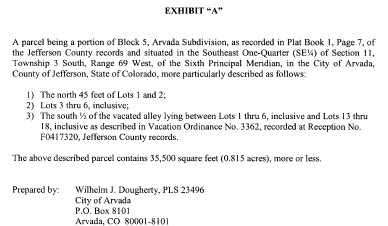
This is the relevant portion of the city council resolution numbering the lots up for seizure. Taken from City Council Agenda for June 26, 2006. The resolution's full title is "07.B.04. CB06-022, An Ordinance Authorizing the Acquisition of Property in the Vicinity of 57th Ave and Webser[sic] Street for Arvada Public Library Parking Improvements"


This is the county assessor's real estate divisions of the southeast block from the first photo. The lots up for seizure run from west to east, 1-6. Note how the loss of such property would cut off any potential expansion for the school, which already uses the northern half of the block. (County Assessor Maps in PDF)


This is a map scanned from page 59 of the Olde Town Renaissance report, written in 1999. It substantiates the report immediately below that the city or its consultants have in the past entertained the idea of building residences on the parish's property. The larger block of text on St. Anne's current property describes the highlighted part of the block as "New Development(Housing along street front, parking deck behind)." The smaller text immediately to the left of the school reads "Easement for through pedestrian traffic." Though the Supreme Court's Kelo decision is unlikely to apply here, its shadow certainly lurks in the minds of those suspicious of the City Council.

For a sense of the cramped proportions of Olde Town Arvada, see the Google map to get a feel for the land.

Addendum:

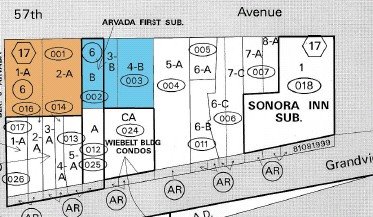
In one news article cited above, the parish's lawyer Bob Frie refers to city land just across the street. One article states "The city land near the church is planned as a site for future housing, city officials have said." Here is the planned site for future housing, just south of the parish property and just southeast of the new library:


As I understand it, the blue and orange lots are the city properties marked for housing developments. This graphic comes from Arvada Urban Renwal Authority's Webster Center Request for Proposal, available in PDF. This request announces:
Arvada Urban Renewal Authority (AURA) is seeking a developer for a key location in Historic Olde Town Arvada and a property with future light rail potential.

AURA is issuing a Request for Proposal for .44 acres, strategically located on the southeast corner of Webster and 57th Avenue in the heart of Olde Town Arvada. This site is located across the street from the new Jefferson County public library, currently under construction. The Olde Town library is scheduled to open in the fall of 2006 and anticipates having 40,000 visitors per month. Furthermore, it is ½ block from a proposed light rail station.

AURA envisions a two or three story residential or mixed use building. Outlined below is a brief summary of the City of Arvada, Olde Town and the Webster Center site.


I mentioned the shadow of the Kelo v. New London decision above. Though I believe Colorado law already restricts eminent domain use, here we see how easily eminent domain restrictions can be avoided: even if useful government-owned property is available, the government can still take away somebody else's land if it has a "public use" fig-leaf serving as an excuse. Worse yet, the government can wait until its property is sold off or irreversibly committed to other purposes, at which point its demands for condemnation under eminent domain appear more reasonable.

Addendum #2

Here is a map for the Webster Center Request for Proposal, curiously omitting any depiction of the school on the property right across the street from it:


Considering the demographics the Arvada Urban Renewal Authority is attempting to attract, one wonders what role the school will play in a future "renewed" neighborhood. From the Webster Center RFP:
Water Tower Village:

Adjacent to Olde Town is a 26-acre parcel that is currently being developed into a high-end residential urban village. The Water Tower Village will house approximately 1,700 people within a mix of rowhouses, cottages, lofts and apartments ? all within easy walking distance of Olde Town. The first residents moved into the community at the beginning of 2005.

Average Household Income: $80,000
Average Age: 32

St. Anne's Land Condemnation: Local Reactions Uniformly Opposed to City

The Arvada Press website appears delinquent in publishing recent letters to the editor, so I have transcribed the relevant local letters on the possible eminent domain condemnation of St. Anne's below.

I find the first letter of June 29, 2006 remarkable because it suggests "good faith" is a prefabricated buzzword of city negotiators, the phrase having also appeared in the CBS4 story linked above. It seems to be an attempt to poison the arguments of any who object. I am surprised at the unanimous dissent of local writers.

"City pursuing St. Anne's property at all costs"

The June 1 Arvada Press had an article titled "City wants land for New Library parking" by Neda Raouf.

At the first Friday Meeting this month at the American Legion Wilmore Richer Post #161, Mr. Bill Ray, deputy city manager, appeared in place of Craig Kocian, the City Manager, who was out of town. He said the story in the Arvada Press concerning condemnation of St. Anne's propety was not accurate or true.

After the meeting was over, the deputy city manager approached me and told me the problem existed and is taking so long to negotiate because officials at St. Anne's Church did not bargain in "good faith."

In a book titled Wadsworth/Grandview Environmental Assessment, on page 3-86 is a map whose source is Arvada Intermodel Village Plan, 2002. The map shows outlines of townhouses on St. Anne's property way back in 2002. The city of Arvada did not own the property then and still does not own the property.

This aggressive maneuver can lead people to think that the city acquiring the property is a done deal, which is the farthest from the truth. One can think this is another attempt to intimidate the people of St. Anne's Parish. This is by no means a noble service provided by the people of our city government.

I allege that the city of Arvada is abusing its authority. If there is to be any condemnation in this matter, it should be directed at the city officials who created this mess.

Nick D.
Arvada


From the July 6, 2006 issue of Arvada Press:

"City Lied About Parking Lot"

I was a participant in the light rail/community redevelopment forum about six weeks ago. During that meeting, several people expressed concern their property might be subject to eminent domain condemnation. An Arvada city representative stated that this could not happen, because according to Colorado State law, cities do not have the right to exercise eminent domain. Now, according to the article published in this week's edition of the Mile High News, "the Arvada City Council approved an ordinance to use eminent domain to acquire the lot owned by Shrine of St. Anne's Catholic Church." Clearly, we were lied to at the Light Rail/Community Redevelopment Forum.
Rich E.
Arvada


"Arvada Should Back Away From Eminent Domain"

Arvada is acting like a bully in attempting to acquire the St. Anne property by condemnation or threat of condemnation. Where were the city officials and council when the library site in old town was first considered? A private citizen wanting to develop a piece of property would be required to meet parking requirements before a building permit would be issued. While the city doesn't need a building permit, certainly the counicl and responsible city department heads should have considered the need for parking without the necessity of taking property of St. Anne's which has plans of its own that are just as important, if not more so, than those of the city. Citizens should be outraged by the double standard that the city is trying to implement.

Construction of the library at the new location should never have been approved. But the City Council seems determined to remake old town from a sow's ear into a silk purse, for reasons not readily apparent or justified. The council's determination to revitalize old town Arvada at all costs has already produced an unduly constricted main street that vehicles cannot easily traverse. Rather than place the new library on property that everyone could be proud of, the council with its limited vision and forseight elected to bury the new library amongst the clutter of old structures, which increases the lack of parking in the area. To say the least, the city should use property it already owns instead of trying to destroy the future plans of the church.

I am not a member of St. Anne's nor of the Catholic faith, but what the city has done and is attempting to do is wrong and reprehensible.

Val M.
Arvada


See also the remarks posted at the Arvada Press Story, remarks often low in quality but clearly in opposition to the city. I repeat my surprise at the unanimity here. I have not followed local politics much, but it is plain to see that many citizens are skeptical of their representatives' city planning abilities and their motivations.

Thursday, July 06, 2006

The Punditry and the Literati have converged on Aspen for the Aspen Institute.

I particularly enjoyed Ross Douthat's take on a lecture discussing Aesthetic Absolutism of a Platonic style.

St. George in the Dock

His dragon-slaying heroics have kept his legend alive through the centuries.

But the Church of England is considering rejecting England's patron saint St George on the grounds that his image is too warlike and may offend Muslims.

Clergy have started a campaign to replace George with St Alban, a Christian martyr in Roman Britain.
The Daily Mail via CWNews.com


Saint George lived in Palestine. He is the patron saint of Lebanon and is traditionally venerated by many Middle East Christians. That outreach to a Middle-Eastern people results in the demotion of a saint native to the region demonstrates the irrational caprice of multicultural abnegation.

In Defense of Mayor Nagin

New Orleans resident "Romulus" defends his mayor from those suffering delusions of omnicompetence:

Amelia, please understand the bankruptcy of the blame game, which is being cheered on by talk radio and political shout shows, by provocateurs whose object is not public safety but managing perceptions and scoring points off the opposition. Don't let yourself be used. I know this is America where everything comes with a money back guarantee and the customer is never supposed to go away dissatisfied, but in the real world, things go wrong even with the best of intentions. We live in a fallen world, and Stuff Happens. When a catastrophic earthquake next strikes San Francisco or Los Angeles, will they have the resources to provide for half a million of its most helpless, disorderly, and improvident citizens? I doubt it.

No one who wasn't here and doesn't have an intimate knowledge of this city is in a position to hold any opinion about how matters were handled here. Talking heads get paid to talk like instant experts, and I don?t suppose there?s any way we can get them to shut up. But that doesn't mean the rest of us have to take them seriously.


Romulus makes similar comments over at BettNet.

Wednesday, July 05, 2006

Beware of Certainty-Substitutes

Notes to Future Generations of Just Warriors

I've remarked before on a number of occasions that when evaluating the criteria for a just war, a ton of gravity doesn't equal an ounce of certainty.

[...]

The "one percent doctrine" is when a one percent chance of a grave event like a WMD attack is responded to as though it were a certainty. Basically it represents an attempt to make gravity and certainty mutually fungible as a basis for action: to make significant enough gravity act as a substitute for certainty.
-Zippy Catholic


Beware lasting, grave, and certain hypothetical scenarios. Beware arguments that are chains of a thousand subjunctives, but seem in summary to be logical works of the utmost realism and clarity. Be aware that soldiers are taught just war doctrine, while their civilian commanders are taught realpolitik.

Zippy's choice phrase, the certainty-substitute, needed currency back when Condoleeza Rice was, with utmost gravity, declaring that we couldn't wait for a mushroom cloud over DC to act.

The One Percent Doctrine Zippy summarizes could have as its motto "I can't believe it's not certainty!" It is double-edged, though only its hawkish edge has been doing any cutting. While there might be a one percent possibility Tinpot Dictator A will give WMDs to Terrorist Group B, there is an equally hypothetical possibility that post-invasion chaos will land said devices in Group B's hands anyway.

That one percent is a fig-leaf of fear used to clothe otherwise unacceptable arguments. That that leaf wasn't lifted earlier is a misfortune of immense proportions.

Meet Executive Supremacy, Same as Judicial Supremacy

The current disputes about executive authority and the judicial system have reminded me of an essay by legal great Robert P. George, Lincoln on Judicial Despotism.

George argues for a strong executive who would in matters of abortion rights both follow Lincoln's unilateral reinterpretation of Dredd Scott and emulate his focused disrespect for judicial authority:

"For Lincoln, then, the evil of the Dred Scott decision was not merely the expansion of slavery. It was that the decision threatened to undermine the basic principles of republican government precisely by establishing judicial supremacy in matters of constitutional interpretation. It was not merely that the Court decided the suit in favor of the wrong party. It was that the Court claimed authority to decide for the other branches once and for all what the Constitution required, thus placing them in a position of inferiority and subservience.

[...]

In office, Lincoln gave effect to his position against judicial supremacy by consistently refusing to treat the Dred Scott decision as creating a rule of law binding on the executive branch. His administration issued passports and other documents to free blacks, thus treating them as citizens of the United States despite the Court's denial of their status as citizens. He signed legislation that plainly placed restrictions on slavery in the western territories in defiance of Taney's ruling."


The parallels to contemporary political turf wars are obvious: selective interpretations, outright disobedience, and appeals to wartime necessity as the trump card of jursiprudence.

While attacking judicial supremacy under the banner of powers co-equal in authority, George's position has only aided arguments for executive supremacy. And executive power is being wielded not for the protection of the unborn, but for the ultimate authority of the president to define the scope of his wartime powers. Roe v. Wade, with the assistance of Robert P. George and George W. Bush, might have done far more damage to the rule of law than even the most pessimistic soothsayers have predicted.

A Deficit of Patriotic Imagery

For the Fourth of July I meant to write a patriotic post taking down crude denunciations of so-called "blood and soil" conservatives, but by way of Daniel Larison I discover that Chris Roach has beat me to it. He even cites the same three songs I would have cited.

Patriotic anthems shouting praises to our landscapes and to our ancestors easily refute the cheap "Blut und Boden" smears attempted every so often by idolators of the civil religion. Such writers show an outright disdain for soil, preferring ethereal principles of governance to the peoples and the country which begat such principles. They often present newly-sworn citizens as the civic superiors of the native-born, invariably insulting the loyalty of life-long Americans. They are the nationalist counterparts to the campus leftists who discover all varieties of bigotry in the unwashed masses. Little wonder there is a backlash against immigration.

But in unexpected ways. This weekend I attended mass at a small mountain parish in the Fraser River Valley. The recessional hymn, if that is the right word, was in fact America the Beautiful. I am always wary of mixing civil religion with the real kind. This same parish once sang the Battle Hymn of the Republic, whose peans to the divine qualities of the Union Army should be wince-inducing even to non-Southerners like myself. Yet despite America the Beautiful's questionable liturgical fitness, there was an added power to the hymn's lines "purple mountains majesty" because, gazing over the altar through the church's rear window, my eyes were fixed upon one of the towering blue peaks encircling the valley. That land is my land, that land is our land.

Looking through the later verses, one worries America the Beautiful shows signs of a relic from another era, like Perry Como's song I Wanna Go Home With You Tonight or Jimmy Durante's A Husband--A Wife. First, to state the obvious, the anthem is a prayer for divine assistance, a certified secularist-repellent if there ever was one. Second, it depicts America as flawed, a country incomplete. Sloganeering descriptions of America as "the greatest nation on God's green earth" cannot find much of an ally here. The lines "Confirm thy soul in self-control,/Thy liberty in law!" strikes hard at the antinomial and libertine ideals for the country. "Till selfish gain no longer stain/The banner of the free!" doesn't bode well for the cruder advocates of globalism, market capitalism, and self-interest wrongly understood. Finally, we find the lines

O beautiful for patriot dream
That sees beyond the years
Thine alabaster cities gleam
Undimmed by human tears!


While maintaining a hopeful spirit, this song is a certain rebuke of utopianism. The best of cities is an aspirational dream, not an imminent state of life. These cities are beyond the temporal sphere and achievable only through a penitent populace beseeching divine intervention. Even in a multi-confessional nation, the song almost translates naked civic deism into "Thy kingdom come, Thy will be done."

How do we explain the paucity of contemporary civic hymnody? Aside from a general decline in musical and lyrical talents, an overemphasis on abstract thought and the dimunition of concrete deeds seems a likely culprit.

Depersonalizing tendencies are one of the greatest weakness of abstraction. Concepts personified, as exemplified by Lady Liberty, seem stark and inhuman. In the case of liberty, this is likely a side-effect of our impoverished understanding of what freedom is for. Yet other modern political concepts would fare just as poorly when personified. Tolerance brings to mind an unflattering portrait of a woman who, though having a polite, forced smile on her face, holds her nose as various odors offend it. Diversity could not be expressed in a single personification except as caricature--a thousand-headed hydra with a teratomatic torso. When one asks how Equality could be depicted in statuary, the mind boggles.

The older concepts, which in truth are not concepts but virtues, lack this problem because they are habits, activities directed towards the good. Since captured activity is the aim of portraiture, the old virtues flourish when personified. Bougereau's Charity shows a tired mother nevertheless suckling and sheltering her demanding brood. Justice, though blinded, bears a sword and scales--her action is imminent, her judgement fearsome. Lady Liberty only threatens a torch-burn, if she can ever shed her paralysis.

It is no accident that Plato's Republic used the image of a human being writ large to discern the characteristics of justice, since virtues have no substance independent of acting persons. Likewise, patriotism has no substance without a people and its patria. A country's early heroes and the landscape on which they once walked are all objects of common patriotic love. One cannot love a mental principle like "all men are created equal" any more than one can admire an ideal triangle. National Anthem are love songs powered not by principles but by images and imagery. Philosophy begins in wonder, and so does poetry. The patriotic imagination approaches the tangible while political principle, as interpreted by its modern devotees, approaches the undetectable. No wonder the older tradition has better songs and stronger loyalties.

Tuesday, July 04, 2006

Say, does that star-spangled banner yet wave
Over the land of the free, and the home of the brave?