Showing posts with label art. Show all posts

Tuesday, December 15, 2009

A schoolkid echoes Holbein and gets suspended

In the latest oddity of our fear-driven age, a second grader in Taunton, Mass. has been suspended over a drawing of Jesus and told to undergo psychological evaluation (at his parents' expense).

His artwork:


"...because he put Xs in the eyes of Jesus, the teacher was alarmed and they told the parents they thought it was violent," an educational consultant with the Associated Advocacy Center told the Taunton Gazette.

It may be too effusive to say so, but this child's iconography shows a deep theological truth. The Crucifixion was no mere illusion of death.

Perhaps that realization hit the teacher too closely.

The drawing itself is like a child's version of the Jesus in Hans Holbein's painting "The Body of the Dead Christ in the Tomb."


Note the disturbed reaction to that painting from Ippolit, the death-obsessed character in Dostoevsky's The Idiot:

"Looking at that picture, you get the impression of nature as some enormous, implacable, and dumb beast, or, to put it more correctly, much more correctly, though it may seem strange, as some huge engine of the latest design, which has senselessly seized, cut to pieces, and swallowed up--impassively and unfeelingly--a great and priceless Being, a Being worth the whole of nature and all its laws, worth the entire earth, which was perhaps created solely for the coming of that Being!

...The people surrounding the dead man, none of whom is shown in the picture, must have been overwhelmed by a feeling of terrible anguish and dismay on that evening which had shattered all their hopes and almost all their beliefs at one fell blow. They must have parted in a state of the most dreadful terror, though each of them carried away within him a mighty thought which could never be wrested from him."


Forget a psych exam, get that kid a paintbrush.

Update: The Associated Press claims that the school district denies the father's account. How will this turn out?

Saturday, December 29, 2007

George Washington: An American Legend with an RPG

Wandering through Denver's "LoDo" section last night, I walked by the Sloane Gallery of Art. The art in the window display, part of a Russian artists exhibit, arrested me where I stood. The most remarkable piece:


Any man whose heart does not leap upon seeing George Washington astride a Roc-sized bald eagle as he wields an RPG is either dead or un-American. Stephen Colbert needs this kind of imagery in the Colbert Report's opening credits.

The surrealism increases:


What rough beast, its hour come 'round at last, wriggles in the arms of the Father of the Country?


This scene reminds us that Washington is one of the few presidents to have killed another man in close-quarters combat. George should play hurly-burly with the head of Hitler. Stalin's noggin should be mounted above the gates of the White House.


V.I. Lenin wearing Washington's mask. A subtle comment on the Trotskyite roots of pompously patriotic neo-conservatives? An intimation that the monetary system is communist plot? Nah, it's just a creepy portrait.

I don't think Americans could produce so extreme a parody of monumental art, though they certainly can commission it. Vitaly Komar and Alexander Melamid developed these paintings for the 1998 opera Naked Revolution. The artists' home page links to more photos from the opera. Local coverage of the art collection, whose owner lives in Denver, is found in the Rocky Mountain News and in Westword.

Wednesday, May 30, 2007

Local Art

I've been informed that an acquaintance of mine, Ron Zito, has a website displaying his paintings. Though I was not impressed by the first images I saw on his site, I dug a bit deeper. There are some stunningly good prints. As Plato says, at the sight of beauty the soul sprouts wings.

Monday, May 22, 2006

Daniel Mitsui: Increase the Number of Cultural Drop-Outs

Via Godsbody, a jeremiad from a master artist exhorting us to "stop drinking the vampire's blood" that is pop culture:
In our modern culture, intellectually insulting and aesthetically offensive art is not only ubiquitous - it is popular, and immensely profitable, in a way that it never was previously. And the reason is that the art of our modern culture is unnatural - it is not produced by a collective genius, piety and intelligence, developed over time through tradition. It is produced by an enormous machine - the industry of entertainment, which is governed only by its own avarice.
Part I

I think that the attitude of evangelization needs to be the same as that of true sacred art - we need to stop thinking about what effect we are having on our audience and altering our methods is anticipation of its response - and to simply be faithful. To communicate the divinely revealed truth in the most precise way possible, letting the message dictate the method. To do otherwise is to make the same mistake as abusers of the liturgy - it is to not trust our faith to succeed on its own merits. If we think that our message is so unappealing that it needs to be dressed up as something else, then we can expect everyone else to concur that it is indeed unappealing. Part II


Daniel Mitsui also has a post on music and one on Latin palindromes.

Sunday, February 26, 2006

A Notable Local Artist

The Arvada Center has a exhibit of the rather intriguing work of pastel artist Riva Sweetrocket.

Surrealist yet accessible, she's one of the better recent artists I've seen on display. "The Power of Thought," depicting fighting doves where a woman's head should be, captures nicely the mental conflict of everyday life. The piece "Steak Out" I took to have been inspired by various womens' magazines, an interpretation surprisingly close to the artist's intent.

Her other pieces are certainly worth browsing.

Friday, January 20, 2006

Googlewars: Jesuit Saint vs. Commie Scum


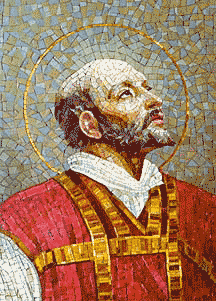
The St. Ignatius Loyola mosaic at Jesuit Mark Mossa's weblog bears an uncanny resemblance to the images which pop up in this Google Image Search on Lenin.

Was there a Charlie Chaplin-Hitler thing going on? It is said that Lenin quite admired some passages in the Spiritual Exercises, as well as the success of the Jesuit order. Then again, perhaps the mosaic artist was an admirer of Lenin.

Friday, August 05, 2005

Art, She is Not Dead

Back in the late eighties I saw my first computer-generated cartoon. A field trip to the National Renewable Energy Labs, (or was it the National Center for Atmospheric Research?) up near Boulder ended with our class sitting in a small theater watching an exquisitely-crafted CGI cartoon about a love story between a bird and a fish who lived with all their fellows in a large sphere. As any kid would be, I was utterly entranced with the short piece. A few years later, I made a ray-traced picture for a chess club flyer using good old POV-ray, a small freeware program. It looked great, especially since somebody else had built the framework for the chess piece models.

Of course, I quickly forgot about POV, and it never entered my mind until I discovered the POV Hall of Fame and CGTalk.com's Choice Gallery. Sci-fi, fantasy, M.C. Escher, and Terry Gilliam's films are obvious influences. But at the moment what particularly strikes me about the medium is its many artists' dedication to realism--even if it is "magical" realism. Supposedly realism in painting declined with the invention of the photographic camera. But now that CGI artists are attempting to make nearly photorealistic portrayals of the images in their mind, it looks like the style might be up for renewal.

In the better art galleries, one comes across students planted in front of some finely-made painting with an easel and a pallette, hoping to learn the techniques of the masters. Likewise, some CG artists try to recreate classic works. There is an admirable attempt at remaking Jan Vermeer's Girl with a Pearl Earring, and one talented artist has made a stunning copy of Michaelangelo's Pieta.

A few "magical realist" pieces that caught my eye are Medieval Airport and one called Family, a snapshot of life amid a sea of pipes and machinery.

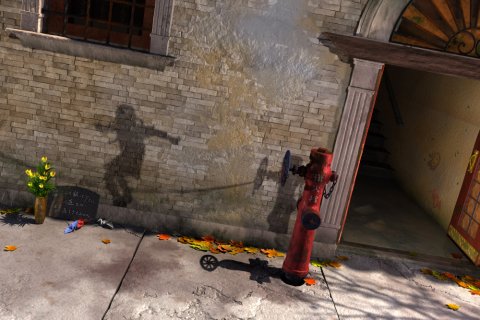
But perhaps the saddest artwork I have found in this medium is Innocent Shadow, depicting one small space in Nagasaki a few years after the atomic bombing.

Tuesday, May 10, 2005

Scruton on Kitsch: The Sacred on Sale!

This is why the loss of religious certainty facilitated the birth of kitsch. Faith exalts the human heart, removing it from the marketplace, making it sacred and unexchangeable. Under the jurisdiction of religion, our deeper feelings are sacralized, so as to become raw material for the ethical life, the life lived in judgment. When faith declines, however, the sacred loses one of its most important forms of protection from marauders; the heart can now more easily be captured and put on sale. Some things—the human heart is one of them—can be bought and sold only if they are first denatured. The Christmas-card sentiments advertise what cannot be advertised without ceasing to be: hence the emotion that they offer is fake.

-Roger Scruton, Kitsch and the Modern Predicament

via Michael Brendan Dougherty


Every ceremony, every ritual, every public display of emotion can be kitsched—and inevitably will be kitsched, unless controlled by some severe critical discipline. (Think of the Disneyland versions of monarchical and state occasions that are rapidly replacing the old stately forms.) It is impossible to flee from kitsch by taking refuge in religion, when religion itself is kitsch. The "modernization" of the Roman Catholic Mass and the Anglican prayer book were really a "kitschification": and attempts at liturgical art are now poxed all over with the same disease. The day-to-day services of the Christian churches are embarrassing reminders of the fact that religion is losing its sublime godwardness and turning instead toward the world of fake sentiment.


So true. Here's the aesthetic argument against the LifeTeen barbarization of the liturgy and the priests who ride bicycles into the sanctuary during their homilies to "connect with the laity," by which they mean "audience." I suspect this is related to "ovation inflation," where nobody ever boos at a performance; the sentiment that one is a sophisticated and appreciative person is far more important than forming and then expressing one's sense of the aesthetic. Sentimentalists wouldn't be so bad, nor indeed sentimentalists, if it there were somebody there to shoot them every minute of their life.

Preachers and Sunday School teachers are conscious that some of the biblical imagery is not easily recognized: few people have ever tasted a pomegranate, or know what it is like to be a shepherd. Catholic preachers always make sure to clarify what the Gospel meant when it implies that Jesus had biological brothers.

I have yet to see somebody analyze from a local pulpit what Our Lord meant when he told us to become as little children. In many contemporary minds, the child is some sentimental bundle of joy who never sins, a true innocent. Some atheist propagandist, perhaps even a well-known one like Russell or Dawkins, seized on the exhortation to become little children, interpreting childhood in the sentimental sense that has become so widespread in the churches, and cited it as a reason that freethinking was for "adults," and religion for spoiled children. I am told by my betters that Our Lord meant us to imitate the humilty of the child, not his self-centeredness, acknowledging our weaknesses and failures and having a recognition that our desires have not yet reached maturity. Such a child sure wouldn't frivolously modify the divine liturgy, knowing that he does not and perhaps never could understand all its intricacies.

See also: Edward T. Oakes, Icons and Kitsch

Tuesday, April 05, 2005

The Petrine Connection

I just realized that Raphael's Aristotle looks a lot like depictions of Saint Peter. Maybe I could base a poorly written best-selling novel on this.

Saturday, March 19, 2005

Not the Castle I was Thinking Of

I let out a howling "NO!" when I heard that the IRS had seized a Colorado castle from its owner and putting it up for auction. The only local castle I know of, Bishop Castle, was hand-built out of rocks by one man. It's now about 160 feet tall, whose height the aged builder still scales without the help of equipment or the safety of a harness, and it still gains additions yearly.

The castle for sale is in fact a bit older and was built by people hired by a coal baron. The first actually looks medieval and wonderfully gothic in its somewhat haphazard construction, while the second looks like a vanity mansion made for the wealthy. It is comforting to know that there are two nearby redoubts to which I may escape once the barbarian mutant cannibals and their robot overlords take power.

Monday, November 25, 2002