Fr. Athanasius Kircher, SJ, was a genuine Renaissance Man of the 17th century. A logician, a mathematician, a vulcanologist, a phonologist, an Egyptologist...
His position as "alpha scholar" is secure enough. Just read what New Advent and Wikipedia have to say of his accomplishments.
Now Western Confucian points us to a Tarantella dance he composed:
"With all his learning and vast amount of adulation which he received on all sides, Kircher retained throughout his life a deep humility and a childlike piety," the old Catholic Encyclopedia writes.
Truly, a model for every intellectual.
Showing posts with label jesuits. Show all posts
Showing posts with label jesuits. Show all posts
Saturday, November 07, 2009

Wednesday, February 20, 2008
Priorities, Priorities
George Weigel, who will lecture in Boulder on tomorrow, Thursday, night, devotes his latest column to considering the problems facing the Jesuit order and its new superior Father Adolfo Nicolas.
In order, Weigel complains about Jesuit disobedience, citing a Boston College priest who advocates homosexual marriage. Fidelity of Jesuit colleges is another problem Weigel mentions. The largely homosexual decadence of certain California Jesuits also receives a drubbing.
Then, finally, Weigel laments "the tendency among some Jesuit theologians to minimize the unique salvific role of Christ."
Shouldn't the Christological concerns have come first?
The corruption in the Society of Jesus deserves plenty of critics, especially good critics.
But it is part of that very corruption to place theological errors at the periphery, to prefer debates about morality over truthful proclamations of Christ.
In order, Weigel complains about Jesuit disobedience, citing a Boston College priest who advocates homosexual marriage. Fidelity of Jesuit colleges is another problem Weigel mentions. The largely homosexual decadence of certain California Jesuits also receives a drubbing.
Then, finally, Weigel laments "the tendency among some Jesuit theologians to minimize the unique salvific role of Christ."
Shouldn't the Christological concerns have come first?
The corruption in the Society of Jesus deserves plenty of critics, especially good critics.
But it is part of that very corruption to place theological errors at the periphery, to prefer debates about morality over truthful proclamations of Christ.
Thursday, November 08, 2007
Commonweal Doesn't Get the Joke
Diogenes recently dolloped more cynicism upon the Jesuits' magazine America:
A writer at the Commonweal blog sniffs: "You'll notice that none of the editorial's 253 words endorses Brown's views on abortion." That rather misses the joke. The elevated language conceals a significant lapse in Mr. Brown's duties towards the less fortunate. The praise given to such public figures is as uniform as it is ubiquitous, which makes the "translation" all the more biting.
Commonweal blogger Grant Gallicho seems obtuse to this shade, preferring to blast Diogenes as a bitter tendentious commentator. But this little joke can function in all sorts of other contexts where diplomatic happy talk overshadows the real crimes in which prominent men are complicit. Just imagine the potential for a quote praising to the heavens some Republican, followed by the line
"Translation: he's pro-torture."
This satire blindness seems uncharacteristic of Commonweal. They like Stephen Colbert, don't they?
More discouraging is their attempts to unmask the pseudonym. They claim the CWNews scribe is Paul Mankowski, SJ. While the pseudonym can mask all sorts of unmerited asperities, of which Diogenes has sometimes been guilty, how else other than pseudonymously could a cleric talk frankly without soiling the dignity of his office and his ministry?
America Magazine is editorially enraptured by British Prime Minister Gordon Brown.
The son of a Presbyterian minister, Brown seems guided by a moral vision that sees it as the government's duty to help the less fortunate.
Translation: he's pro-abortion.
A writer at the Commonweal blog sniffs: "You'll notice that none of the editorial's 253 words endorses Brown's views on abortion." That rather misses the joke. The elevated language conceals a significant lapse in Mr. Brown's duties towards the less fortunate. The praise given to such public figures is as uniform as it is ubiquitous, which makes the "translation" all the more biting.
Commonweal blogger Grant Gallicho seems obtuse to this shade, preferring to blast Diogenes as a bitter tendentious commentator. But this little joke can function in all sorts of other contexts where diplomatic happy talk overshadows the real crimes in which prominent men are complicit. Just imagine the potential for a quote praising to the heavens some Republican, followed by the line
"Translation: he's pro-torture."
This satire blindness seems uncharacteristic of Commonweal. They like Stephen Colbert, don't they?
More discouraging is their attempts to unmask the pseudonym. They claim the CWNews scribe is Paul Mankowski, SJ. While the pseudonym can mask all sorts of unmerited asperities, of which Diogenes has sometimes been guilty, how else other than pseudonymously could a cleric talk frankly without soiling the dignity of his office and his ministry?
Thursday, March 22, 2007
2007 Gerard Manley Hopkins Conference This Weekend
Regis University is again hosting her superb conference on the work of religious poet Gerard Manley Hopkins, SJ. Details are not yet on-line, though some information is here.
Wednesday, October 11, 2006
Jesuit Education At Work
The horror, the horror....
And all this time I thought the "hive mind" was a universal pejorative.
With enthusiasm, Dr. Raymond Reyes, the associate vice-president for Diversity at Gonzaga University, encouraged Regis faculty during the Fall Faculty Conference to get out of their chairs and "sing the world into being!" Faculty and staff attendees then moved their hips, clapped their hands, and smiled in good cheer as they addressed serious issues of diversity and social justice.
[...]
Furthering his discussion of diversity, Reyes also spoke of "the spirit of the hive." Connecting the idea of diversity to the Jesuit Mission, Reyes believed that in working together as bees do, we as a university community can "R.S.V.P God."
Regis University Student Newspaper
And all this time I thought the "hive mind" was a universal pejorative.
Wednesday, June 28, 2006
Against Neo-Jesuits
I am up to my ears in 16th century Jesuitdom because I am researching a project. Therefore I know that the Society of St. Ignatius and the Society of Pedro Arrupe have little to do with each other. And most Jesuits on the planet today are disciples of Pedro Arrupe, not disciples of Inigo de Loyola. And most of them realize it, in that they will acknowledge the morphing of the Society, but they think that St. Ignatius is smiling on the change. Thus the rationalization, "He was a man of his time." Which makes me want to wheeze fabada out of my nostrils at them.
I am convinced that he would tell them that he was a man of his time before the cannonball, and that afterwards, he was a man of God's time, as they should be. I am convinced because *I* could not have come up with something that eloquent, so it must have come from him whispering in my ear.
Some Have Hats
The comments to the post are similar in tone. "Supress the Jesuits!" and the like. We've all seen it before and my eyes roll like a busted slot machine. But THEN some Jesuit guy (one of the solid, orthodox, good ones, too) responds. And it's the SAME rote response. That is to say: "Problem? What problem?" and he goes to (rightly) make mention of all that is good, holy, decent and admirable about the current state of the Company to bolster the notion that all is both hunky and dory in Jesuitville. But it isn't. This isn't a spreadsheet where Fr. X's lunacies are canceled out by Fr. Y's holiness. On this blog and Karen's group blog, I make an effort to exalt the positive aspects of the Jesuits such as I see them. But that doesn't mean there aren't problems, and gravely serious problems at that, in the Society of Jesus.
This drives me UP THE [insert bad word]ING WALL. Yes, there are good, solid, orthodox Jesuits. Maybe even TONS of them. But they are being done a grave disservice by the attitude that, because there are solid/orthodox Jesuits, everything is just peachy-fine. Boston College is not Barely Catholic, Fr. Drinan is an exemplary servant of Christ, that whole "gays in the seminary" thing doesn't really mean anything nudge-nudge-wink-wink, legalized abortion is "lamentable" but military action in Lower Elbonia is an abomination, and Jesus certainly would have favored a confiscatory tax rate and socialized medicine.
AMDG Blog
Wednesday, March 08, 2006
G.M. Hopkins Conference Coming Soon to Denver!
For any Denverites reading this, Regis University will soon host its annual Gerard Manley Hopkins Conference discussing the master poet and Jesuit priest. Thus saith the website:
Peter Milward, SJ, of Sophia University, Japan will be a presenter, as will novelist Ron Hansen. Once again, Shakespearean actor Richard Austin will provide excellent recitations of Hopkins' poems, recorded copies of which are available for purchase on his website.
Last year excepted, I have been a regular attendee at the conference since its inception. Highly recommended.
[Also: with the exception of the banquet, all events are free and open to the public!]
The 2006 Hopkins International Conference will be held at Regis University, Denver, Colorado from March 24th to March 26th. Accommodation has been reserved at the Comfort Inn/Brown Palace Hotel in downtown Denver.
Peter Milward, SJ, of Sophia University, Japan will be a presenter, as will novelist Ron Hansen. Once again, Shakespearean actor Richard Austin will provide excellent recitations of Hopkins' poems, recorded copies of which are available for purchase on his website.
Last year excepted, I have been a regular attendee at the conference since its inception. Highly recommended.
[Also: with the exception of the banquet, all events are free and open to the public!]
Thursday, February 09, 2006
How Ignatius Loyola Avoided Violence Over a Religious Insult
The furor in the Islamic world evoked by various cartoons deprecating Mohammed brings to mind an event from the life of Saint Ignatius of Loyola recorded in his autobiography .
.
After Ignatius had set out to become a saint, a Moor insulted the Virgin Mary in his presence and he seriously considered shedding the man's blood in return. Speaking of himself in the third person, he writes:
. After Ignatius had set out to become a saint, a Moor insulted the Virgin Mary in his presence and he seriously considered shedding the man's blood in return. Speaking of himself in the third person, he writes:
On the way something happened to him which it will be good to record, so one may understand how Our Lord dealt with his soul, which was still blind, though greatly desirous of serving Him in every way which he knew. [...] He did not dwell on any interior thing, nor did he know what humility was or charity or patience or discretion to regulate and measure these virtues. Without considering any more particular circumstance, his every intention was to do these great external works because the saints had done so for the glory of God.
As he was going on his way, then, a Moor riding on a mule came up to him, and they went on talking together. They began to talk about Our Lady, and the Moor said it seemed to him that the Virgin had indeed conceived without a man, but he could not believe that she remained a virgin after giving birth. In support of this he cited the natural reasons that suggested themselves to him. The pilgrim, in spite of the many reasons he gave him, could not dissuade him from this opinion. The Moor then went on ahead so rapidly that he lost sight of him, and he was left to think about what had transpired with the Moor. Various emotions came over him and caused discontentment in his soul, as it seemed to him that he had not done his duty. This also aroused his indignation against the Moor, for he thought that he had done wrong in allowing the Moor to say such things about Our Lady and that he was obliged to defend her honor. A desire came over him to go in search of the moor and strike him with his dagger for what he had said. He struggled with this conflict of desires for a long time, uncertain to the end what he was obliged to do. The Moor, who had gone on ahead, had told him that he was going to a place a little farther on, very near the highway, though the highway did not pass through the place.
Tired of examining what would be best to do and not finding any guiding principle, he decided as follows, to let the mule go with the reins slack as far as the place where the road separated. If the mule took the village road, he would seek out the Moor and strike him; if the mule did not go toward the village but kept on the highway, he would let him be. He did as proposed. Although the village was little more than thirty or forty paces away, and the road to it was very broad and very good, Our Lord willed that the mule took the highway and not the village road.
Wednesday, February 08, 2006
On The Novelty of Tuition for Jesuit Colleges
Since the Second Vatican Council, the order of the Society of Jesus has often sought to return to the charism and the way of life of its first members. There is one ancient regulation that has been ignored, described in a Catholic history of St. Louis, Missouri:
Perhaps the sons of Ignatius of Loyola could correct this oversight, turing away from elite money and elite opinion and turning towards economic poverty for the sake of free education.
When the Jesuit college opened on the edge of town in l829, Father Peter Verhaegen headed it. On December 28, l832, Missouri governor Daniel Dunkin signed the bill that made Saint Louis University the first university west of the Mississippi. According to Jesuit rule, priests could not charge tuition for their work. However, on January l3, l833, Pope Gregory XVI, at the request of Rosati, signed a dispensation that allowed the university to charge tuition–one of the most significant changes in the Jesuit way of conducting schools since the founding of the Society of Jesus.
Perhaps the sons of Ignatius of Loyola could correct this oversight, turing away from elite money and elite opinion and turning towards economic poverty for the sake of free education.
Monday, January 30, 2006
Jesuits' Taste In Poetry Slightly Improves
The 2004 winner of America magazine's poetry contest was an unbelievably bad poem. The 2005 winner describes an imagined slave ship tossing its human cargo overboard. Its quality is improved, but still awkward. The Jesuit editors must have a taste for mediocre moralism.
The poem's unfortunate comparison of school buses with slave ships makes the theme break from strain. It recalls a ditty of mock-profundity I wrote in high school, its first line having appeared to me in a dream:
All Hail the Mighty School Bus,
That fiendish yellow beast
Which carts away childhood
Like bandits in the night.
Yet some congratulation is due to John Hodgen, who has surpassed the admittedly low standard of Tryphon Tolides.
The poem's unfortunate comparison of school buses with slave ships makes the theme break from strain. It recalls a ditty of mock-profundity I wrote in high school, its first line having appeared to me in a dream:
All Hail the Mighty School Bus,
That fiendish yellow beast
Which carts away childhood
Like bandits in the night.
Yet some congratulation is due to John Hodgen, who has surpassed the admittedly low standard of Tryphon Tolides.
Friday, January 20, 2006
Googlewars: Jesuit Saint vs. Commie Scum
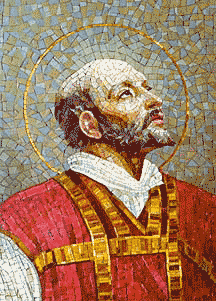
The St. Ignatius Loyola mosaic at Jesuit Mark Mossa's weblog bears an uncanny resemblance to the images which pop up in this Google Image Search on Lenin.
Was there a Charlie Chaplin-Hitler thing going on? It is said that Lenin quite admired some passages in the Spiritual Exercises, as well as the success of the Jesuit order. Then again, perhaps the mosaic artist was an admirer of Lenin.
Wednesday, January 18, 2006
Yech! SDS at Regis.
The Students for a Democratic Society, whose alumnus Tom Hayden has been mentioned in these pages, is attempting a revival. Their website indicates a Regis chapter is in the works. Where have all the Tories gone?
The Jesuits should never have started charging tuition. Fees are so exorbitant now that only the scions of Jacobin capitalists can easily attend.
The Jesuits should never have started charging tuition. Fees are so exorbitant now that only the scions of Jacobin capitalists can easily attend.
Friday, December 23, 2005
Philokalia Republic: Quoted in Reuters!
Reuters has picked up the America advertisment flap, citing this site's faux-humble scribe:
Of course, I immediately see some awkwardness in my phrasing. A perfectionist's self-critique is never done.
They likely found me by way of cwnews.com's Off the Record post on the same topic.
Anyway: Mainstream Media, here I come!
Another writer on the Philokalia Republic blog called on America's editors to apologize, but noted, "It does seem an irreverent artist was trying to incite a controversy for free advertising."
Of course, I immediately see some awkwardness in my phrasing. A perfectionist's self-critique is never done.
They likely found me by way of cwnews.com's Off the Record post on the same topic.
Anyway: Mainstream Media, here I come!
Thursday, December 15, 2005
Looks like the First Housecleaning Didn't Take[CORRECTION]
At the Jesuits' magazine America. Jody Bottum Reports an advertisement showing a statue of the Virgin Mary wearing what appears to be a condom. It is derisively named "Extra Virgin."
Addendum:
I stopped by the library for confirmation, and though it definitely seems to be a condom(being a servile and unthinking Catholic, I've never seen one outside of its wrapper), it is just subtle enough that an impious advertiser could have slipped it past an absent-minded editor. I will reserve further judgement until the editors respond to the questions which this will inevitably provoke. If they spinelessly defend the ad, their bad faith will be obvious. However, a full apology to the Blessed Virgin, to her Son, and to America's readers would do a great deal to restore their reputation.
Addendum #2:
Those who complain report receiving the following e-mail:
It does seem an irreverent artist was trying to incite a controversy for free advertising. I hope the editors of America recommend their readers to say a novena for the troubled man, and I applaud them for acknowledging such a grievous error.
Addendum:
I stopped by the library for confirmation, and though it definitely seems to be a condom(being a servile and unthinking Catholic, I've never seen one outside of its wrapper), it is just subtle enough that an impious advertiser could have slipped it past an absent-minded editor. I will reserve further judgement until the editors respond to the questions which this will inevitably provoke. If they spinelessly defend the ad, their bad faith will be obvious. However, a full apology to the Blessed Virgin, to her Son, and to America's readers would do a great deal to restore their reputation.
Addendum #2:
Those who complain report receiving the following e-mail:
December 15, 2005
Dear Reader:
We too are offended and very much regret we did not catch the mistake prior to publication. We are returning payment for the ad and protesting the abuse to the artist.
The problem was not evident in the black and white proofs we have used to check final copy.We are taking a number of new steps to review advertising in advance of publication.
Thank you for being so attentive.
Sincerely,
Drew Christiansen, S. J.
Editor in Chief
It does seem an irreverent artist was trying to incite a controversy for free advertising. I hope the editors of America recommend their readers to say a novena for the troubled man, and I applaud them for acknowledging such a grievous error.
Sunday, October 30, 2005
Rene Descartes: Secret Jesuit Agent
According to the account given in his notebook - no copy of which exists, but which has been reconstructed using contemporary reports - Descartes formulated his philosophy of methodical doubt after a day in a stove-heated room and an ensuing night of extraordinary dreams. Grayling points out that the dreams were remarkably similar to those described in Rosicrucian texts. It is known that Descartes had many acquaintances among the Rosicrucians. Can we be sure that the intrepid rationalist was not a secret intellectual ally of these hermetic thinkers? Grayling thinks it unlikely, and makes the intriguing suggestion that Descartes may have been a spy working in the service of the Jesuits, who formed contacts with the Rosicrucians as part of an intelligence-gathering operation. In the nature of the case, there can be no proof, but it leaves the philosopher looking a surprisingly adventurous figure.
John Gray's Bookshop
Monday, June 27, 2005
For Future Reference
Pontifications has posted the interesting essay “I am in the Church” by Jean Danielou, S.J. It seems to have been written in the '70s.
Sunday, May 08, 2005
High School College Counselors get Free Junkets
Wisconsin counselors have been among the crowd to visit Regis University, a small Jesuit college in Denver.
Although the majority of the one-week trip focuses on the university's academics, the last day gives counselors a chance to ski, snowboard or visit a spa at nearby resorts. Those services could be free or discounted, said Regis spokeswoman Lee Ann Fleming. Showcasing "where students play" also is an important side to the campus, she said.
"We certainly don't have any apologies about where we are," Fleming said. "We want to emphasize the academics and then say that they are situated in one of the most beautiful places in the world."
via this place
Friday, April 15, 2005
Jesuits Discover Most Overrated Poet Of 2004
Pay Him $1000 For Publishing Rights
I was surprised to discover that America magazine has a $1000 annual prize for poetry. But I was extremely surprised at how laughably bad I found the 2004 winner. I had thought that the decline of the Jesuit order was only obvious in its public dissent and its inability to generate interested novices, but this poem indicates that the rot is much deeper; even the Jesuits' academic excellence, which some contemporary Jesuit universities seem to treat as the only virtue, is endangered.
For now, the bad poem is located at this website but I reproduce it below:
I think the last line is the best line in the poem, both in the mean sense that one is joyful it is finished, but also because it evokes a movement towards uncertainty that otherwise is not present in this moralizing mess of "prose-poetry." But of course the poem fails miserably there, too, since it doesn't take enough space to explore the uncertainty. This takes the saying "poetry does nothing" far too literally, since there is really no movement in it. It's just a simplified version of the old Sesame Street "one of these things is not like the other" game, which, needless to say, wasn't all that complex to begin with.
I passed this on to a doctoral student in English lit, and she wrote the following reply, off-the-cuff:
I've long wondered whether Maritain rightly defended the aesthete's saying ars gratia artis(art for art's sake) in Art and Scholasticism, but this poem makes me even more sympathetic to Maritain's analysis. I don't even know if this is blank verse. Some critic once said that writing blank verse was like playing tennis without a net. This "award-winning poet" isn't even playing with a stringed racket. One wonders if it is a joke, since the would-be poet's name looks like it could be a Hellenic pseudonym. A google search proves otherwise, alas. America indicates it received over 1,300 submission for its poetry contest, which suggest the following:
1) The poetry editor is incompetent.
2) The poetry editor is corrupt, granting the award out of personal or ideological favoritism.
3) The poetry contest itself is just an economic attempt to expand America's reader base by purchasing cultural cachet.
4) Any "poets" who read America are so bad that we need a superlative form of the superlative "most talentless."
In all honesty, I think my juvenalia was better written than this poem. Lots of it was on "poetic" things, too, like sleep, aging, and death. Considering the competition, perhaps I should shake the dust from my quill. Auberon Waugh, I believe, established the bad sex writing contest. Perhaps a bad poetry contest would do wonders towards the improvement of modern poetics.
Gerard Manley Hopkins, pray for us!
Addendum:
Not that it is terribly difficult to do, but I have found a mouse poem that easily bests Tryfon's attempt.
All it needs is another stanza beginning "I think war is quite a bore," and it'll even capture the award-winning poet's botched efforts at contrasting the differences between mice and men.
I should mention that I heard the better poem while enjoying the commercial-free radio provided by my ISP. What station? The children's channel, of course.
Addendum #2:
This is actually the second piece of evidence in a month that America is intellectually sub-par. One of their columnists copied part of his speech from the Rainbow Sash Coalition, without attribution.
Addendum #3:
William Luse is having a poetry contest inspired by our hapless prize-winner: make a better mouse poem!
I was surprised to discover that America magazine has a $1000 annual prize for poetry. But I was extremely surprised at how laughably bad I found the 2004 winner. I had thought that the decline of the Jesuit order was only obvious in its public dissent and its inability to generate interested novices, but this poem indicates that the rot is much deeper; even the Jesuits' academic excellence, which some contemporary Jesuit universities seem to treat as the only virtue, is endangered.
For now, the bad poem is located at this website but I reproduce it below:
The Mouse and the Human
By Tryfon Tolides
The mouse doesn't really bother anyone. It doesn't
go around holding up banks or shooting people
in the face or locking them up in dank jail cells
and sticking electric prods to their genitals. It doesn't
build jet fighters and bomb our cities in the name
of peace in the middle of the night while we are sleeping.
It doesn't plant toy mines to blow our children's arms off.
All the mouse wants is to share with us some shelter,
food, even the warmth of its nervous body. Yet we plug up
the cupboards so it can't eat, and we chase it around
the living room with a broom and remove all the chairs
till it has nowhere to hide; then we club it to death
as it squeals. Or we set up traps with something it likes
to lure it into strangulation and burst its eyes out
of its head. And against what? A few light scratchings
heard in the ceiling once in a while keeping us company
at night? Two or three crumbs of bread taken from
the kitchen floor? And after the mouse, there are the ants
to be poisoned, the bees to be gassed and burned.
Later, the dandelions to be choked by spraying. And after
that, after that, there must be something after that.
I think the last line is the best line in the poem, both in the mean sense that one is joyful it is finished, but also because it evokes a movement towards uncertainty that otherwise is not present in this moralizing mess of "prose-poetry." But of course the poem fails miserably there, too, since it doesn't take enough space to explore the uncertainty. This takes the saying "poetry does nothing" far too literally, since there is really no movement in it. It's just a simplified version of the old Sesame Street "one of these things is not like the other" game, which, needless to say, wasn't all that complex to begin with.
I passed this on to a doctoral student in English lit, and she wrote the following reply, off-the-cuff:
...this poem makes me want to cry. Or laugh. Or
beat my head against the wall. Hey, if I organize the lines properly,
that would count as poetry, wouldn't it?
"Poem on the poem that won the contest sponsored by America"This stupid mouse poem, so naive
and unlyrical:
Moves me to despair
agony and self-torment. Only now do I understand
why hermits whipped themselves with thorns:
They had seen the future of poetry
and they saw that it was bad.
Note my 'clever' disregard for punctuation, capitalization, and
sentence structure. That's how you can tell it's a poem.
I've long wondered whether Maritain rightly defended the aesthete's saying ars gratia artis(art for art's sake) in Art and Scholasticism, but this poem makes me even more sympathetic to Maritain's analysis. I don't even know if this is blank verse. Some critic once said that writing blank verse was like playing tennis without a net. This "award-winning poet" isn't even playing with a stringed racket. One wonders if it is a joke, since the would-be poet's name looks like it could be a Hellenic pseudonym. A google search proves otherwise, alas. America indicates it received over 1,300 submission for its poetry contest, which suggest the following:
1) The poetry editor is incompetent.
2) The poetry editor is corrupt, granting the award out of personal or ideological favoritism.
3) The poetry contest itself is just an economic attempt to expand America's reader base by purchasing cultural cachet.
4) Any "poets" who read America are so bad that we need a superlative form of the superlative "most talentless."
In all honesty, I think my juvenalia was better written than this poem. Lots of it was on "poetic" things, too, like sleep, aging, and death. Considering the competition, perhaps I should shake the dust from my quill. Auberon Waugh, I believe, established the bad sex writing contest. Perhaps a bad poetry contest would do wonders towards the improvement of modern poetics.
Gerard Manley Hopkins, pray for us!
Addendum:
Not that it is terribly difficult to do, but I have found a mouse poem that easily bests Tryfon's attempt.
MICE
by Rose Fyleman
I think mice are rather nice;
Their tails are long, their faces small;
They haven't any chins at all.
Their ears are pink, their teeth are white,
They run about the house at night;
They nibble things they shouldn't touch,
and, no one seems to like them much,
but, I think mice are rather nice.
All it needs is another stanza beginning "I think war is quite a bore," and it'll even capture the award-winning poet's botched efforts at contrasting the differences between mice and men.
I should mention that I heard the better poem while enjoying the commercial-free radio provided by my ISP. What station? The children's channel, of course.
Addendum #2:
This is actually the second piece of evidence in a month that America is intellectually sub-par. One of their columnists copied part of his speech from the Rainbow Sash Coalition, without attribution.
Addendum #3:
William Luse is having a poetry contest inspired by our hapless prize-winner: make a better mouse poem!
Sunday, April 10, 2005
Setting the World Ablaze Begins with Oneself
No, I am not talking about self-immolation. "Romulus," a true Catholic gentleman, has reminded me of the Apothegmata Patrum, the sayings of the Desert Fathers, with a brief, wonderful selection:
Come to think of it, the epiphany of the burning bush which Moses witnessed is a perfect image of grace at work: just as the bush was burning but not consumed, so too does grace transform and transfigure our nature.
Abba Lot came to visit Abba Joseph and said: "Abba, when I am able, I recite a short office, I fast a little, I pray, I meditate, I stay recollected. As far as I can I try to keep my thought pure. What else should I do?"
Then Abba Joseph got up. He stretched out his hands to heaven and his fingers became like burning lamps.
He said to Abba Lot: "If you will, become all fire."
Come to think of it, the epiphany of the burning bush which Moses witnessed is a perfect image of grace at work: just as the bush was burning but not consumed, so too does grace transform and transfigure our nature.
And this is certain, since obedience is a holocaust in which the whole man without the slightest reserve is offered in the fire of charity to his Creator and Lord through the hands of His ministers.
-St. Ignatius Loyola, Letter "On Perfect Obedience" Rome, March 26, 1553
Friday, April 08, 2005
A Local Jesuit on the Pope
The pope, of happy memory, was in Denver in 1993 and visited the local Catholic university, Regis. The Jesuit President of Regis reflects on meeting JPII
Father Sheeran relates a nice story of a younger Chelsea Clinton enthusiastic about meeting the pope. It also contains this very interesting paragraph:
A couple of points:
US aid to Muslims via the Catholic Vatican might be more acceptable than directly from the US herself? Either this was a castle in the sky suggestion, or things are quite different in the Muslim world than one's first impressions suggest.
Wouldn't this raise all sorts of constitutional church-state issues?
And I wonder who first suggested it: Clinton or John Paul?
Father Sheeran relates a nice story of a younger Chelsea Clinton enthusiastic about meeting the pope. It also contains this very interesting paragraph:
John Paul shook hands with everyone in the crowd and seemed to draw strength out of the encounters as he stood taller and walked with more confidence. A few minutes later, he greeted the President and they went into a private dining room for an hour’s conversation. Officially, it was protocol: The American head of state welcoming Vatican City’s head of state. But both men wanted a quiet place to get to know each other. Their hour of conversation reportedly involved practical issues like how the pope could encourage the Catholic Croats to seek peace with the Orthodox Serbs and how U.S. humanitarian relief to Muslim countries might be made more acceptable by placing Vatican seals on the boxes.
A couple of points:
US aid to Muslims via the Catholic Vatican might be more acceptable than directly from the US herself? Either this was a castle in the sky suggestion, or things are quite different in the Muslim world than one's first impressions suggest.
Wouldn't this raise all sorts of constitutional church-state issues?
And I wonder who first suggested it: Clinton or John Paul?
Subscribe to:
Posts (Atom)